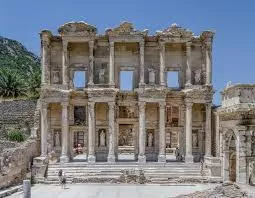
The Library of Celsus: The Complete History of Ephesus' Most Famous Building
Stand in front of the Library of Celsus and you're looking at the most photographed ruin in Turkey — a two-storey marble façade that has become the unofficial symbol of Ephesus itself. But the building's real story is stranger than most visitors realise. It's a library that doubled as a tomb, a monument built by a grieving son, destroyed by fire and earthquake, and pieced back together stone by stone in the 1970s.
This guide covers the full history of the Library of Celsus: who built it and why, what it looked like in its prime, how it was destroyed, and what you'll actually see when you visit today.
Who Built the Library of Celsus — and Why?
The Library of Celsus was commissioned around 110–114 AD by Tiberius Julius Aquila , a Roman consul, in memory of his father, Tiberius Julius Celsus Polemaeanus . Construction was completed by Aquila's heirs around 117–135 AD, during the reign of Emperor Hadrian.
Celsus himself is one of the most remarkable figures of the Roman East. Born an Anatolian Greek, he rose through the Roman political system to become a senator, consul in Rome in 92 AD, and eventually proconsul (governor) of the province of Asia — one of the first men of Greek descent ever to reach such heights in the Empire. He was wealthy, well-educated, and by all accounts genuinely loved in Ephesus, the city he governed.
When Celsus died, his son did something almost unheard of in the Roman world: he buried his father inside the city walls — an honor normally forbidden — and built a magnificent public library over the tomb. A partially surviving inscription beside the entrance records that Aquila funded the building, its decoration, and its books from his own wealth, and left 25,000 denarii for the library's upkeep and the purchase of new scrolls.
So the Library of Celsus is really two buildings in one: a working public library above, and a mausoleum below.
The Third-Greatest Library of the Ancient World
At its height, the Library of Celsus held an estimated 12,000 scrolls , making it the third-largest library in the Greco-Roman world — behind only the legendary libraries of Alexandria and Pergamon. For a provincial city, even one as important as Ephesus, that was an extraordinary distinction.
The scrolls were stored in tiered wall niches, likely fitted with wooden shelving cabinets called armaria . Behind the niches, the architects built a clever double-wall system — an air gap that regulated humidity and protected the fragile papyrus from the damp Aegean climate. Readers reached the upper tiers by staircases built into the walls, and the single great reading hall faced east, so morning light flooded in for early scholars.
The Tomb Beneath the Floor
Here's the detail most visitors walk right over — literally. Beneath the abscess at the back of the reading hall lies a sealed crypt containing Celsus' marble sarcophagus , decorated with reliefs of Eros, Nike, rosettes and garlands, with a lead coffin inside.
The sarcophagus was rediscovered during excavations in 1904 and has never been opened. Celsus is still there, nearly 1,900 years later, resting beneath the feet of the millions of tourists who photograph his monument every year.
The Façade: Ancient Architecture's Cleverest Optical Illusion
The famous two-storey facade is a masterpiece of Hadrianic-era design — and full of visual tricks:
The central columns are taller than those at the edges, a deliberate distortion that makes the building appear larger and more imposing than its footprint (roughly 21 meters wide and 17 meters high) would allow. The library was squeezed onto a small plot between existing buildings, so its architects made it feel monumental instead.
Nine marble steps lead up to the entrance, flanked by inscriptions in Greek and Latin describing Celsus' life and career. In four niches across the lower facade stand statues of women personifying the four virtues of Celsus: Sophia (wisdom), Arete (virtue), Ennoia (insight) and Episteme (knowledge). The originals were taken to Vienna during early excavations — what you see today are faithful copies, with the originals held in the Ephesus Museum in Vienna.
And while the façade shows two storeys from outside, the interior originally rose in three tiers of shelving — another sleight of hand to maximize storage.
Destruction: Fire, Goths and Earthquakes
The library's working life lasted less than 150 years. In 262 AD , a devastating fire — attributed either to an earthquake or to the invading Goths — gutted the interior and destroyed the entire collection of scrolls. Only the face survived.
The Ephesians patched up the ruin in the 4th century and even installed a decorative fountain in front of the steps, but the building never functioned as a library again. Sometime in the 10th or 11th century, a final earthquake brought the façade crashing down, and the Library of Celsus lay in fragments for the better part of a thousand years.
The 1970s Reconstruction: How the Façade Rose Again
What you see today is the result of one of archeology's great jigsaw puzzles. After the site was excavated in the early 1900s, the fallen fragments of the facade lay catalogued but scattered. Between 1970 and 1978 , a team led by German archaeologist Volker Michael Strocka painfully re-erected the façade using a technique called anastylosis — rebuilding with the original stones wherever possible, and clearly marked modern material where pieces were missing or held in foreign museums.
The result is considered one of the most faithful reconstructions in the ancient world, and it's the reason the Library of Celsus — rather than the far larger Great Theater — became the face of Ephesus.
Visiting the Library of Celsus Today
The library stands at the corner of Curetes Street and the Marble Road, at the very heart of the Ephesus archaeological site — about 20 minutes' drive from Kuşadası cruise port and 30 minutes from Selçuk.
A few tips from our local team:
Go early or go late. The façade faces east, so morning light is spectacular — but so are the cruise crowds by mid-morning. Arriving at opening time (or visiting on an evening entry, when available in summer) gives you the famous photo without a hundred strangers in it.
Look for the details. The statue bases, the Greek and Latin inscriptions on the steps, the carved acanthus leaves and fasces symbols on the façade — most visitors photograph and move on. The story is in the stonework.
Remember what's beneath you. When you stand before the abscess inside, Celsus' sealed sarcophagus is directly below.
The easiest way to experience the library with real context is with a licensed local guide. Seadrop Travel runs private and small-group Ephesus tours from Kuşadası port and local hotels, timed to beat the crowds — with skip-the-line entry and guides who'll show you the details most visitors miss. Cruise passengers can be back on board with hours to spare.
Frequently Asked Questions About the Library of Celsus
Who built the Library of Celsus?
It was commissioned by the Roman consul Tiberius Julius Aquila around 110–114 AD as a memorial to his father, Tiberius Julius Celsus Polemaeanus, a former governor of the Roman province of Asia. It was completed by Aquila's heirs during Emperor Hadrian's reign.
How old is the Library of Celsus?
Roughly 1,900 years old. Construction began in the 110s AD and finished by around 135 AD.
How many scrolls did the Library of Celsus hold?
Estimates range from 9,000 to 12,000 scrolls, making it the third-largest library of the ancient world after Alexandria and Pergamon.
Is anyone buried in the Library of Celsus?
Yes—Celsus himself. His marble sarcophagus rests in a sealed crypt beneath the abscess of the reading hall. It was rediscovered in 1904 and has never been opened.
What destroyed the Library of Celsus?
A fire in 262 AD — caused by either an earthquake or the Gothic invasion — destroyed the interior and all its scrolls. Later earthquakes toppled the surviving façade around the 10th–11th century.
Is the Library of Celsus original or a reconstruction?
The façade you see today was re-erected between 1970 and 1978 using the original fallen stones wherever possible. It's regarded as one of the most accurate reconstructions in classical archaeology.
How do I visit the Library of Celsus from Kuşadası?
The library sits inside the Ephesus archaeological site, about 20 minutes from Kuşadası cruise port. Seadrop Travel offers private Ephesus tours with hotel and port pickup, skip-the-line entry, and licensed guides.
Planning a day in Ephesus? Browse Seadrop Travel's Ephesus tours and Kuşadası shore excursions for private, crowd-beating itineraries led by local experts.